
If you have ever felt a cool breeze in late August and wondered whether fall has officially arrived, you are not alone. Determining the exact start of autumn depends entirely on whether you are looking at the sky or your calendar.
Understanding these differences helps you plan everything from wardrobe changes to seasonal home decor and outdoor activities. Let’s break down the exact dates for 2026 and explore the two main systems used to mark the arrival of fall.
The Two Ways to Define the First Day of Autumn
Science and everyday life do not always use the same clock. To make sense of when autumn begins, experts divide the year using two distinct systems: astronomy and meteorology.
The Astronomical Autumn: Following the Equinox
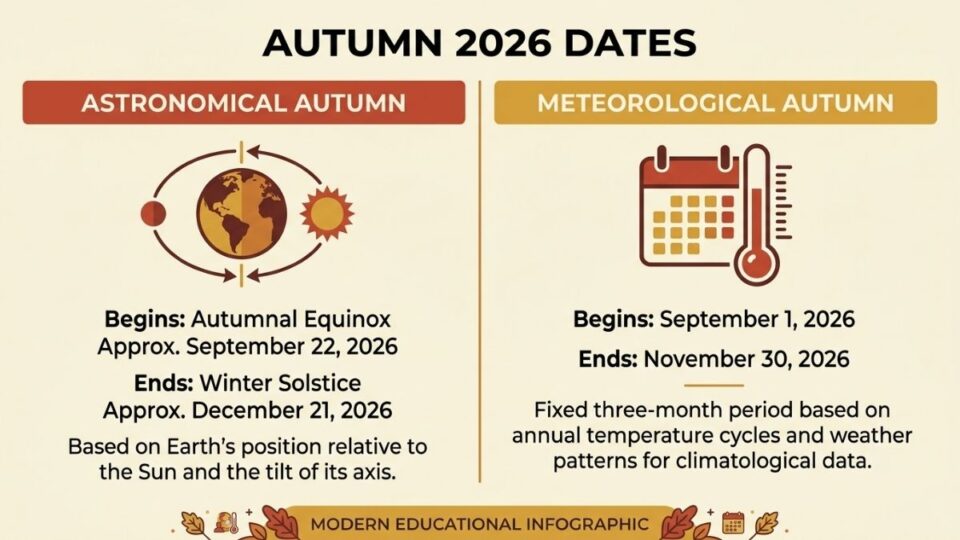
Astronomical autumn is based on the position of the Earth relative to the Sun. It begins on the autumn equinox, the exact moment when the Sun crosses the celestial equator. On this day, day and night are nearly equal in length all around the globe.
Because the Earth’s orbit is slightly elliptical and takes roughly 365.25 days to complete, the exact date of the equinox shifts slightly each year, usually falling between September 21 and September 24 in the Northern Hemisphere.
The Meteorological Autumn: Simplified for Daily Life
Meteorologists and climatologists prefer a simpler, fixed system. They divide the four seasons into equal three-month periods based on annual temperature cycles rather than astronomical positions.
By grouping months together, meteorologists can easily track weather trends, compile climate stats, and compare historical data year over year without worrying about shifting equinox times.
Exact Dates for Autumn 2026: Mark Your Calendar
Depending on where you live on the planet, the dates for autumn in 2026 vary significantly.
Northern Hemisphere Autumn Dates
For North America, Europe, parts of Asia, and Northern Africa, autumn in 2026 follows these timelines:
- Meteorological Autumn: Begins on September 1, 2026, and ends on November 30, 2026.
- Astronomical Autumn: Begins with the Autumnal Equinox on September 22, 2026, and ends on December 21, 2026 (the Winter Solstice).
| Definition | Start Date | End Date |
| Meteorological | September 1, 2026 | November 30, 2026 |
| Astronomical | September 22, 2026 | December 21, 2026 |
Southern Hemisphere Autumn Dates
If you live in Australia, New Zealand, South America, or Southern Africa, the seasons are reversed:
- Meteorological Autumn: Begins on March 1, 2026, and ends on May 31, 2026.
- Astronomical Autumn: Begins on March 20, 2026, and ends on June 21, 2026.
Beyond modern science and weather reports, human societies have marked the arrival of fall for thousands of years through festivals and agricultural calendars.
Mid-Autumn & East Asian Solar Terms
In Eastern cultures, the traditional calendar breaks the year down into 24 solar terms to guide farming and daily living. Fall officially starts with “Liqiu” (Start of Autumn), which typically lands in early August.
This tradition views early fall as the time when harvest preparation begins, long before the cool weather sets in. To explore how these ancient solar markers influence seasonal shifts throughout the year, check out our comprehensive 24 solar terms guide.
Western Harvest Traditions & Modern Seasonal Shifts
In Western culture, fall has long been associated with harvest festivals, pumpkin patches, and preparing homes for the colder months ahead. Modern lifestyle trends often celebrate the arrival of “pumpkin spice season” as early as late August, bridging the gap between late summer heat and the official calendar dates.
Signs Nature Is Telling You Fall Has Arrived
Even without looking at a calendar, nature provides clear signals when autumn is underway.
Cooling Temperatures & Crisper Air
One of the first signs of fall is a noticeable drop in humidity and cooler nighttime temperatures. As sunlight hours decrease, the air begins to feel crisp, especially during early morning hours.
Leaf Color Changes & Falling Foliage
As daylight hours shorten, deciduous trees stop producing chlorophyll—the pigment responsible for green leaves. This reveals the beautiful underlying pigments of orange, yellow, and red before the leaves eventually drop to conserve energy for winter.
Frequently Asked Questions About Autumn’s Start
Is September 1st officially the first day of autumn?
It depends on the system you use. For meteorologists and weather tracking, yes, September 1st is the official start. However, astronomically, fall does not begin until the September Equinox.
Why does the date of the autumn equinox change every year?
The equinox date shifts slightly because a calendar year (365 days) does not perfectly match the time it takes Earth to orbit the Sun (roughly 365.25 days). Leap years help adjust this discrepancy.
Does autumn start at the same time everywhere in the world?
No. When the Northern Hemisphere transitions into autumn, the Southern Hemisphere enters spring.
Autumn is more than just a date on the calendar—it is a season of transition, cozy moments, and natural transformation. Whether you choose to follow the precision of the astronomical equinox or the practical simplicity of the meteorological calendar, September 2026 marks the perfect time to welcome crisper weather and seasonal warmth into your home.